
Precise and Thorough Leak Detection
Protect Your Pool, Prevent Water Loss, and Avoid Costly Damage
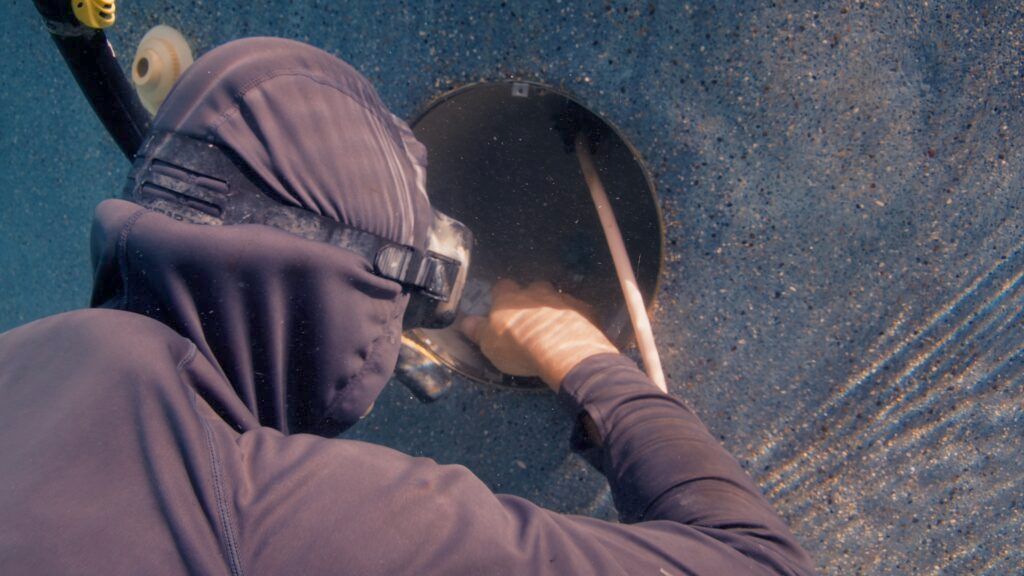
When Advanced Leak Detection arrives, you can expect a comprehensive inspection of your entire system. We isolate and test every component—including lights, drain grates, skimmers (inside and out), return jets, tile lines, interior surfaces, and all plumbing lines. The pump, filter system, and every connected water feature, such as spas and waterfalls, are examined with the same level of detail, even if they are typically considered “untestable.”
If any plumbing line shows signs of leakage during isolation, we pressurize the line and use advanced sonic technology to pinpoint the exact source. Our technicians employ multiple proprietary isolation techniques to ensure every leak is accurately identified and no issue goes undetected.
If the source of the leak is not related to major structural movement, our minor repairs—performed onsite during the leak detection—use proprietary Advanced Epoxy designed to outlast your pool finish. We do not perform low-quality repairs to encourage future upsells. We repair pools as we would our own, using the most sensible and durable solution appropriate to the severity of the issue.
5 BIG REASONS to GET IT FIXED
- It pays for itself (excellent Return On Investment) - Calculating the 4 cost factors below, the repair of your “average” leak will usually pay for itself in less than 6 months (less than 2-3 months for larger leaks). It just makes sense to stop your leak, save money, and have peace of mind.
- Avoid paying inflated water bills - A 1″ water loss in the average pool equals roughly 240-280 gallons. A 240-280-gallon/day leak (or any significant fraction thereof) adds up to several thousand gallons on your monthly water bill. Leaks can cost from $20-$200 (or more) per month (larger leaks, i.e., in commercial pools, can cost thousands per month) just in water bills. Eliminate the waste & give us a call.
- Reduce your chemical costs - Of course, it’s just not water leaving your pool–it’s pool chemicals as well. Leaky pools tend more quickly to get out of chemical balance and create more maintenance problems (more work) for the homeowner. Cloudy water, algae growth, and degradation of the pool interior are all exacerbated by chemical imbalances brought on by a pool leak. You can easily calculate another $15-$25/month in lost chemicals for a moderate leak–much more for larger leaks.
- Avoid (further) structural damage - Fill water normally supplies only about half of the required minerals/chemicals your pool requires–pool water is normally very “hard”. (Rainwater and, similarly, “softened” water depletes pool chemistry the most.) The result is a pool with a diluted water chemistry that will actively seek additional minerals/chemicals from the finish. A leaky pool’s finish (over time) tends to degrade much quicker than a non-leaking pool. This applies mostly to concrete (gunite) pools, but to a lesser degree to fiberglass & vinyl-lined pools. Besides degradation of cementitious finishes, metallic solder and caulking joints (i.e., in pool light niches and skimmers) & tile/grout joints are also very susceptible to diluted water chemistry.
Despite popular belief, leaks rarely “wash” dirt away from the pool. Florida soils are extremely porous & tend to absorb (up to) very high volumes of water flow. Moist soil does, however, compact 10%-15% more than dry soil. Compacting soils “shrink” away (aided by oxidation-shrinkage of organic content) and reduce their support underneath adjoining decks, causing settling & cracking. Because the pool deck lies on top of the pool shell (in gunite pools), shifting decks tends to crack the upper shell of the pool (also known as the beam of the pool). The longer the pool leaks in a certain area, the more the adjoining deck will settle, the more beam cracking will occur, the more leakage will occur. It’s a vicious cycle that only promises to cause more damage over time. Settling decks & soil are also the primary cause of underground plumbing breaks. Again, the longer the leaking pool water compacts and settles the outside adjoining soil, the probability of both structural & plumbing leaks increases. - Prevent equipment failure - Frequently, ongoing leak issues will cause water levels to recede below the skimmer mouth. Homeowners, despite their best efforts, aren’t always around to throw in the fill hose when necessary. This can lead to extended dry-pump conditions, which will ruin the pump. It usually takes at least an hour or more (usually many hours) of the pump running completely dry before enough heat is built up to break the seal & allow pool water to compromise the front bearing. Melted strainer baskets and discolored/distended pump fittings are also signs of dry-pump conditions.